White Paper · MediTrans Insights
Instrument Development Translation and Linguistic Validation: The Roles of Forward Translation and Back Translation
Abstract
Instrument development translation refers to the process of converting assessment instruments used in clinical research into multiple languages. It goes beyond simple linguistic conversion, with the core objective of ensuring conceptual equivalence. This white paper examines the importance of Linguistic Validation in instrument development, with a particular focus on Forward Translation and Back Translation. It also discusses how these processes impact the reliability and validity of clinical data.
1. Introduction
With the increasing number of global clinical studies, the use of standardized assessment instruments across multinational and multilingual settings has become more common. In particular, Patient-Reported Outcomes (PRO) and Quality of Life (QoL) measures serve as key variables in clinical research, and translation accuracy directly affects the validity of study results.
However, simple translation alone is often insufficient to fully convey the meaning of the original instrument, which may lead to distortions in data interpretation. To address this issue, a structured Linguistic Validation process is required.
2. Concept of Instrument Development Translation
Instrument development translation is not a simple linguistic conversion process, but a method of reconstructing an instrument in another language while preserving its conceptual meaning, intent, and measurement purpose. This process includes the following elements:
- Maintaining conceptual equivalence
- Ensuring cultural appropriateness
- Preserving measurement consistency
- Ensuring respondent comprehension
In other words, instrument translation should be understood as a reconstruction process of a measurement tool rather than a literal translation.
3. Role of Forward Translation
Forward Translation is the first step of converting the source text into the target language. The key aspect of this process is preserving conceptual meaning rather than performing a word-for-word translation.
For example, expressions describing emotional states or conditions may lose meaning if translated literally, and must instead be adapted to convey the same concept in the target language.
Forward Translation is characterized by:
- Concept-oriented translation
- Priority on meaning transfer
- Consideration of linguistic naturalness
This step requires not only translation skills but also academic and contextual interpretation.
4. Function of Back Translation
Back Translation is the process of translating the Forward Translation back into the original source language. This step is used to verify translation accuracy.
Back Translation helps identify:
- Meaning distortions
- Conceptual inconsistencies
- Information loss during translation
Even minor differences in meaning may affect measurement outcomes, making Back Translation a critical validation step.
5. Linguistic Validation Procedure
The Linguistic Validation process consists of the following steps:
- Forward Translation
- Reconciliation
- Back Translation
- Expert Review
- Cognitive Debriefing
- Final Review
Figure 1. Linguistic Validation workflow for medical translation, PRO instruments, and clinical trials
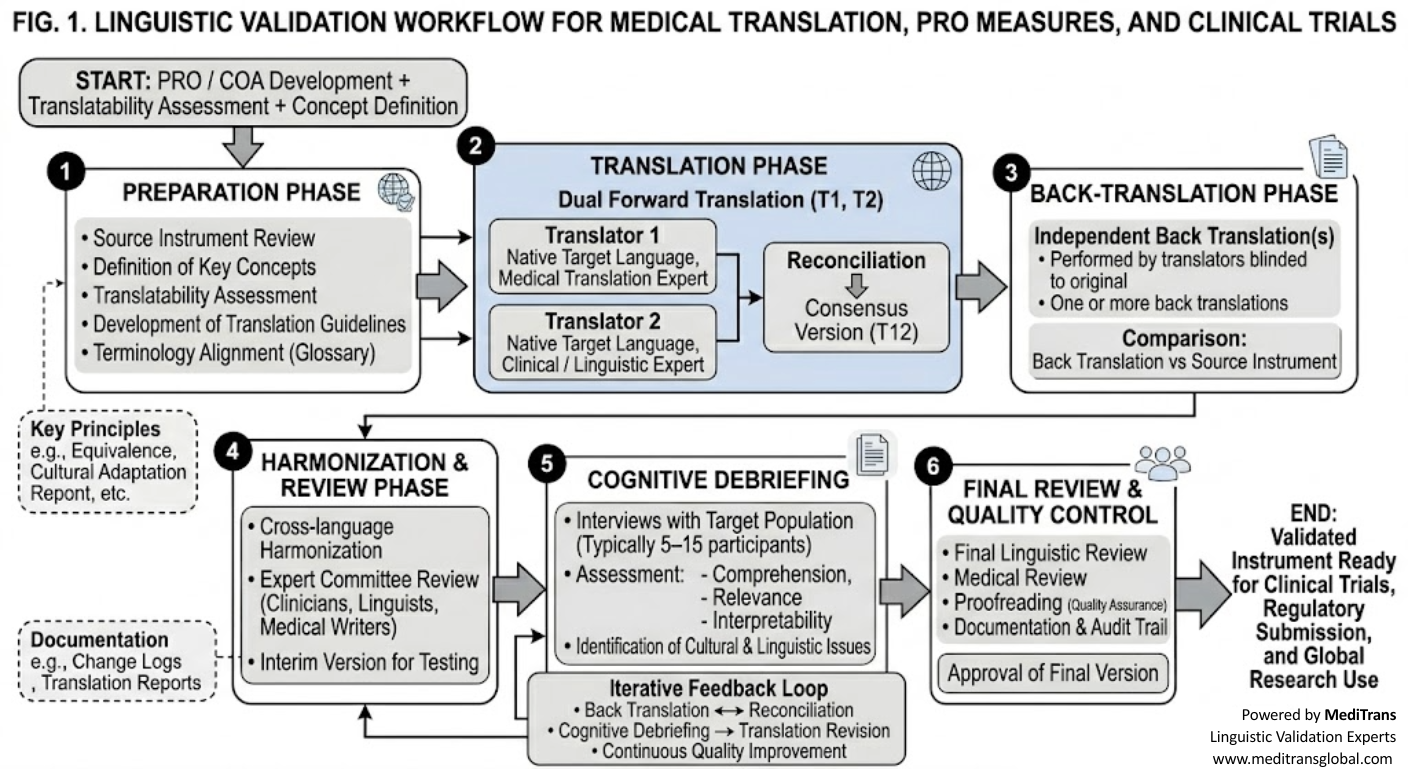
This multi-step validation process is recommended by Good Clinical Practice (GCP) guidelines and major regulatory authorities.
In particular, the Cognitive Debriefing step evaluates how target respondents understand translated items, making it a critical component for assessing practical validity.
6. Common Issues in Instrument Translation
The following issues frequently occur during instrument translation:
- Conceptual distortion due to literal translation
- Interpretation errors caused by cultural differences
- Inconsistencies in response interpretation
- Terminology and expression inconsistency
These issues can significantly reduce data reliability and affect the interpretation of study results.
7. Impact on Instrument Development
Inadequate translation may result in:
- Reduced measurement validity
- Lower reproducibility of results
- Difficulty in cross-country data comparison
- Regulatory submission issues
Therefore, Linguistic Validation should be regarded as a mandatory process rather than an optional step in instrument development.
8. Field Observations
In various instrument development projects, the following recurring issues have been observed:
- Translations that are semantically similar but conceptually different
- Different interpretations of the same item by respondents
- Country-level variation in response patterns
These issues often arise not from translation itself, but from the absence of proper validation procedures.
9. Conclusion
Instrument translation goes beyond simple linguistic conversion and serves as a core process ensuring the reliability and validity of clinical research.
A structured Linguistic Validation process, including Forward and Back Translation, ensures conceptual equivalence and maintains data consistency in multinational studies.
Therefore, a professional Linguistic Validation approach is essential in instrument development.
10. Practical Implication and Service Consideration
Utilizing professional support in instrument development and translation validation is a key strategy for improving research quality.
Meditrans provides the following Linguistic Validation services:
- Forward Translation
- Back Translation
- Expert Review
- Cognitive Debriefing support
- Quality control and validation
Through these services, we support the development of instruments that meet global clinical research standards.
For support in instrument translation, Linguistic Validation, Forward Translation, or Back Translation, please contact Meditrans for professional consulting and validation services.