White Paper · MediTrans Insights
End-to-End Medical Writing and Publication Strategy: A Continuous Approach to Submission and Revision
Abstract
This white paper redefines medical writing not as a standalone document preparation task, but as a continuous publication process that extends from data interpretation to submission, revision, and resubmission. In today’s academic publishing environment, the same research findings may lead to different publication outcomes depending on how reviewer comments are addressed and how effectively the scientific argument is presented. This highlights the growing strategic importance of the revision stage. Conventional medical writing has often focused primarily on manuscript drafting, with limited integration of journal submission strategy and reviewer response management. This fragmented approach can reduce publication efficiency and limit the likelihood of successful publication. To address this gap, this paper presents an end-to-end medical writing framework that integrates data understanding, scientific narrative development, submission strategy, and structured reviewer response. Drawing on experience across diverse clinical and research settings, this paper discusses how data-driven interpretation and integrated scientific communication can improve the coherence, clarity, and persuasiveness of medical manuscripts. Ultimately, medical writing is evolving beyond documentation into a strategic scientific communication function that helps structure, interpret, and communicate research evidence throughout the publication lifecycle.
1. Introduction
For many years, academic publication has been viewed as the final step in documenting research findings. Once a study was completed and the data had been analyzed, medical writing was often understood as the process of organizing those findings into a manuscript and preparing it for journal submission. However, today’s academic publishing environment calls for a broader and more strategic understanding of this role.
A manuscript is not accepted simply because it is well written. After submission, it typically undergoes multiple stages, including initial editorial screening, editor assessment, peer review, responses to reviewer comments, revision, resubmission, and, in many cases, further rounds of review. Throughout this process, publication outcomes are shaped not only by the scientific value of the study, but also by the clarity of the research question, the consistency of data interpretation, the strength of the scientific argument, alignment with the journal’s scope, and the quality of the response to reviewers.
Even when two manuscripts are based on the same dataset and research findings, their publication outcomes may differ depending on how the scientific narrative is framed, which journal is selected, and how reviewer comments are addressed. This suggests that publication is not determined by the quality of the manuscript alone. Rather, it is shaped by a continuous and interactive process that extends from submission through revision and resubmission.
Medical writing, therefore, should not be limited to manuscript preparation. It should be understood as a strategic process that transforms research findings into clear, publication-ready scientific communication. This white paper defines medical writing as an end-to-end process that encompasses data interpretation, scientific narrative development, submission strategy, and revision management, and discusses how this integrated approach can improve academic publication outcomes.
2. Structural Characteristics of the Academic Publication Process
The academic publication process generally follows the sequence below.
- Review of research data and analysis results
- Manuscript drafting
- Target journal selection
- Formatting and preparation of the submission package according to journal guidelines
- Journal submission
- Editorial screening
- Peer review
- Receipt of reviewer comments
- Development of a revision strategy
- Preparation of the response to reviewers
- Submission of the revised manuscript
- Acceptance or further revision
This process should not be viewed as a simple linear pathway. It is more accurately understood as an iterative cycle, with the revision stage after peer review serving as a critical point that can determine both the quality and publishability of the manuscript.
Reviewer feedback is rarely limited to language edits or formatting corrections. In many cases, reviewers evaluate the core scientific structure of the manuscript, including the appropriateness of the study design, the validity of statistical analyses, the interpretation of endpoints, the need for subgroup analyses, the clarity of figures and tables, the balance of the discussion, the presentation of limitations, and whether the conclusions overstate the findings.
Accordingly, revision is not merely a process of correcting errors. It is a process of refining the scientific logic of the study and responding to reviewer questions with evidence-based reasoning. If this stage is handled inadequately, even a scientifically valuable study may face further revision or rejection. Conversely, when reviewer concerns are accurately identified and addressed through clear, well-supported responses, the manuscript’s persuasiveness and likelihood of acceptance can improve substantially.
In this sense, the publication process does not end with manuscript drafting. A critical part of publication success lies in how the questions and critiques that arise after submission are managed, addressed, and incorporated into the revised manuscript.
3. Structural Limitations of Conventional Medical Writing Approaches
Conventional medical writing is often centered on manuscript drafting. In this model, the writer prepares the Introduction, Methods, Results, and Discussion sections based on the data and analysis results provided by researchers, then formats the manuscript according to journal requirements. While this approach may be efficient during the drafting stage, it has several limitations when considered in the context of the full publication process.
First, a disconnect may arise between data interpretation and writing. If manuscript development begins without a sufficient understanding of the research data, the meaning of the findings may be oversimplified, or a logical gap may emerge between the study objective and the interpretation of the results. In clinical research, how endpoints, statistical significance, clinical relevance, and subgroup findings are interpreted can directly influence the strength of the manuscript.
Second, journal selection and submission strategy may be separated from manuscript development. Even for the same study, the structure and emphasis of the manuscript should vary depending on the target journal’s scope, readership, article type, word limit, figure and table requirements, and reporting guidelines. Without a clearly defined submission strategy, a scientifically meaningful manuscript may still face editorial rejection if it does not align with the expectations of the journal.
Third, responses to reviewers may be handled without a clear strategy. Reviewer comments are not simply requests for sentence-level changes. They are part of a broader validation process that examines the logic, interpretation, and presentation of the study. Comments should therefore be assessed by priority, key issue, acceptable revision scope, areas requiring defense, and the potential need for additional analysis. Without this structure, responding to comments one by one may result in a weaker and less persuasive response letter.
Fourth, consistency between the revised manuscript and the response letter may be compromised during revision. Authors may state in the response letter that a specific issue has been addressed, while the manuscript itself does not reflect the change clearly enough. Conversely, the manuscript may be revised appropriately, but the rationale for the change may not be sufficiently explained in the response letter. Such inconsistencies can give reviewers the impression that the response is incomplete or inadequately managed.
As a result, when medical writing is limited to manuscript drafting, the publication potential of the manuscript may be constrained. Effective publication requires that writing, submission, revision, and response management be integrated into one coherent workflow.
4. Functional Redefinition of the Revision Stage
Revision is not simply an exercise in correcting errors. It is a process of reaffirming the scientific soundness of the study, the appropriateness of the interpretation, and the logical completeness of the manuscript in response to the questions raised by reviewers. In this sense, revision should be understood not as correction, but as scientific argumentation.
Reviewer comments can be grouped into several categories according to their nature. Comments related to study design, subject selection, and analytical methods may be understood as methodological comments. These should be addressed by clearly explaining the rationale for the study design and the validity of the methods used, and by providing supplementary analyses where appropriate.
Comments concerning statistical analysis, p-values, confidence intervals, and subgroup analysis fall under statistical comments. In these cases, the appropriateness of the statistical methods should be explained, and the feasibility and relevance of any additional analyses requested by the reviewer should be carefully assessed in light of the research objective and data structure. If additional analyses are performed, the results should be reflected consistently in both the manuscript and the response letter. If they are not performed, the rationale should be explained in an evidence-based manner.
Comments regarding the scope of interpretation or clinical relevance may be understood as interpretation comments. These often arise when reviewers believe that the findings have been overstated or that the clinical implications have not been sufficiently explained. In such cases, the interpretation should be appropriately adjusted, and the meaning of the findings should be clarified in relation to existing literature and the relevant clinical context.
Comments related to manuscript flow, section structure, and the placement of figures and tables may be classified as structural comments. These comments are closely tied to how clearly the manuscript’s scientific message is conveyed to readers and reviewers. Addressing them requires more than simply moving paragraphs or revising tables. It requires reassessing whether the overall narrative connects naturally from the research question to the interpretation of the results.
Finally, comments related to sentence structure, terminology, formatting, and reference style can be categorized as language or editorial comments. Although these may appear to be relatively straightforward, they are closely linked to terminology consistency, clarity of expression, and compliance with journal guidelines. In clinical and medical manuscripts, even subtle differences in wording can affect the strength of a claim or the scope of interpretation. These revisions should therefore be made in a way that preserves scientific accuracy, rather than treated as simple language editing.
To address reviewer comments effectively, it is not enough to draft responses. The intent behind each comment must first be understood. The writer must determine whether the reviewer’s concern relates to the data itself, the interpretation, insufficient explanation, or the way the information is presented. Misreading the intent of a comment can lead to unnecessary revisions or, more importantly, failure to address the reviewer’s core concern.
The response to reviewers is not a simple reply document. It is a scientific communication document designed to persuade reviewers that their concerns have been understood and appropriately addressed. A strong response letter has the following characteristics.
- It demonstrates a clear understanding of the reviewer’s concern.
- It clearly indicates whether revisions were made and where they were made.
- It distinguishes between comments that were accepted and those that were not, while maintaining a respectful and evidence-based tone.
- When additional analyses are performed, it explains the rationale and results clearly.
- It ensures consistency between the revisions made in the manuscript and the explanations provided in the response letter.
- When a point requires defense, it presents a logical argument based on data and literature rather than an emotional rebuttal.
The revision stage is therefore both a process of addressing weaknesses in the manuscript and an opportunity to sharpen its central scientific message. At this stage, the medical writer functions not merely as an editor, but as a strategic communicator who helps align scientific reasoning between researchers and reviewers.
5. End-to-End Medical Writing Framework
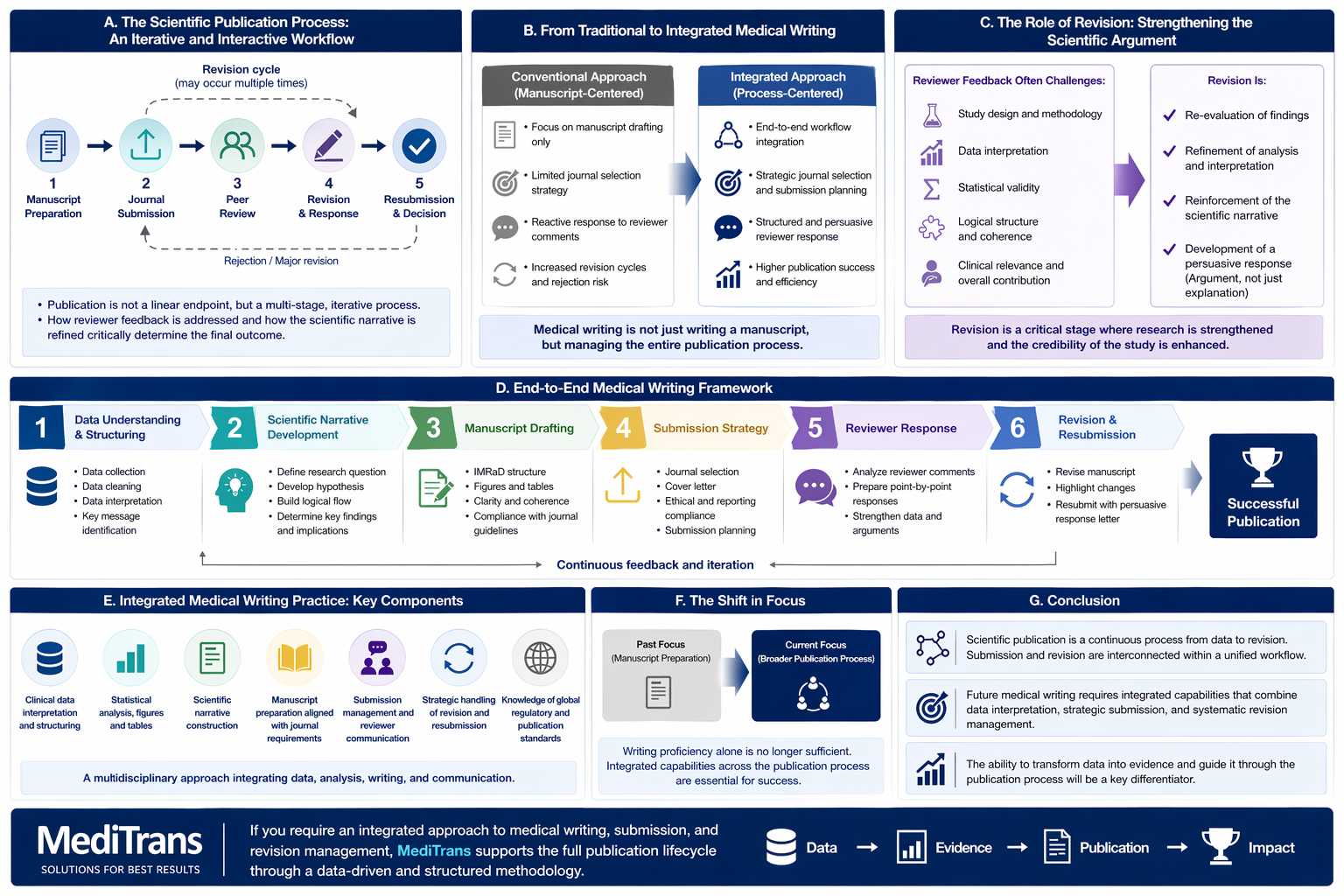 Effective publication requires medical writing to be designed not as a single document preparation task, but as an integrated process that extends from data understanding to submission, peer review response, revision, and resubmission.
The end-to-end medical writing framework presented in this white paper follows the sequence below.
Data understanding and structuring → Scientific narrative development → Manuscript writing → Submission strategy development → Reviewer response → Revision and resubmission
The core principle of this framework is that each stage should be managed as part of a continuous publication pathway, rather than treated as an isolated task. The key messages identified during data interpretation should be reflected in the structure and logical flow of the manuscript. The narrative developed during manuscript preparation should then inform target journal selection and submission strategy. In turn, the questions and critiques raised by reviewers after submission should be used not merely as requests for correction, but as opportunities to refine the manuscript’s logic and strengthen its scientific argument.
End-to-end medical writing is therefore distinct from an approach that treats manuscript writing, submission, and revision as separate stages. It is an integrated approach that helps transform research data into a clear, publication-ready narrative and ensures that this narrative remains consistent throughout peer review and revision.
By applying this approach, the structural quality of the manuscript, the persuasiveness of reviewer responses, and the efficiency of the resubmission process can be improved, ultimately increasing the likelihood of successful publication.
6. Integrated Medical Writing Practice
Across a wide range of clinical research and academic publication projects, the role of medical writing has expanded from document preparation to integrated publication support. This includes data interpretation, development of the manuscript’s logical structure, submission strategy, and revision response. In medical and clinical research, it is not enough to describe the findings accurately. The scientific value of the data must be shaped into a clear narrative that aligns with the expectations of the target journal and the perspectives of potential reviewers.
In practice, the process begins with reviewing the structure of the clinical data and the key findings, identifying the core message aligned with the research objective, and designing the overall flow of the manuscript. Statistical analysis results are then organized into figures and tables, and the manuscript is developed so that the Introduction, Methods, Results, and Discussion are connected within a coherent logical structure. The goal is not simply to present data, but to refine the scientific narrative so that the research question, results, and interpretation are consistently aligned.
At the journal submission stage, the target journal’s scope, author guidelines, article type, word limit, figure and table restrictions, and reference style are reviewed to ensure that the manuscript and submission package meet journal requirements. Cover letter preparation, journal-specific formatting, and supplementary material review are also managed as important components of the publication process.
After peer review, reviewer comments are categorized by type, and the intent and key issue behind each comment are analyzed to develop an appropriate response strategy. At this stage, comments requiring simple language edits are distinguished from those requiring additional data interpretation, methodological explanation, statistical clarification, or refinement of limitations. The revised manuscript and the response to reviewers are managed together to ensure consistency between the two documents. Where necessary, additional analyses or explanatory revisions may be proposed, while comments that cannot be accepted are addressed through respectful, evidence-based rebuttal.
This integrated practice is grounded in the view that manuscript writing, submission, and revision should not be treated as separate tasks, but as connected stages within a continuous publication pathway. In particular, documentation experience across clinical research, medical devices, pharmaceuticals, real-world data, patient-facing materials, and other medical and regulatory settings strengthens the accuracy of data interpretation, consistency of terminology, and precision of scientific reasoning.
Ultimately, medical writing is evolving beyond the preparation of individual documents. It is increasingly serving as a strategic function that helps translate research data into a clear, publication-ready narrative and maintain that narrative throughout submission and revision.
7. Discussion
In today’s academic publishing environment, medical writing is increasingly moving beyond manuscript preparation to encompass the broader publication process. This shift explains why an integrated approach is needed—one that combines data interpretation, scientific narrative development, journal-specific submission strategy, and structured reviewer response.
As the revision stage becomes more important, the focus of manuscript development is also expanding from the manuscript itself to the publication process as a whole. Medical writing is no longer limited to preparing documents. It is becoming a specialized function that shapes the scientific meaning of research findings and communicates that meaning persuasively to journals, reviewers, clinicians, and other stakeholders.
To increase the likelihood of successful publication, the stages of the publication process should not be disconnected from one another. Data analysis should inform the narrative, the narrative should shape the manuscript structure, the manuscript structure should guide the submission strategy, and reviewer comments received after submission should be used to further strengthen the manuscript’s logic and scientific argument.
From this perspective, end-to-end medical writing is not merely an expansion of the writer’s scope of work. It is an approach that reframes the publication process as a strategic scientific communication system. This is particularly important in clinical and medical fields, where the interpretation of research findings may be linked to patient safety, clinical decision-making, product value, and regulatory communication. For this reason, accuracy, clarity, and the strength of the scientific argument are especially critical.
8. Conclusion
Academic publication is not the outcome of a single stage. It is a continuous process that extends from data interpretation to manuscript writing, submission, peer review, revision, and resubmission. Submission and revision, in particular, should not be understood as separate procedures, but as interdependent stages within a continuous publication pathway.
Effective medical writing does not stop at documenting research data. It defines the core message of the study, develops a scientific narrative tailored to the target journal and readership, responds to reviewer questions with evidence-based reasoning, and strengthens the manuscript’s logical completeness through revision.
Going forward, medical writing will require integrated capabilities that include data interpretation, publication strategy, reviewer response, and revision management, rather than writing ability alone. End-to-end medical writing provides a practical framework for responding to this shift and can help enhance both the scientific value and the publication potential of research findings.
MediTrans supports the full publication process by providing integrated publication strategy services, including medical writing, journal submission, and revision response, helping research data be transformed into a publishable scientific message and carried through to final publication.