

1. Introduction
Drug evaluation and pricing systems are increasingly shifting toward a value-based approach, evolving to reflect real-world therapeutic outcomes in clinical practice. This transformation is not merely an adjustment of evaluation criteria, but a fundamental shift in how the value of pharmaceuticals is defined.
In South Korea, this trend is being institutionalized through the 2026 pharmaceutical pricing reform. The revised system emphasizes rapid reimbursement listing for new drugs, outcome-based post-listing reassessment, and enhanced cost-effectiveness evaluation frameworks. This indicates a shift from one-time assessments at a fixed point in time to a continuous evidence-generation process based on real-world clinical data.
2. Expanding Data Requirements in Pharmaceutical Pricing Policy
The traditional pricing framework has primarily relied on Randomized Controlled Trials (RCTs), focusing on outcomes derived from controlled environments and limited patient populations.
However, this approach has limitations in reflecting real-world clinical practice, including patient heterogeneity, treatment patterns, and adherence behaviors. Under the revised system, real-world treatment outcomes become a critical evaluation factor, and drug pricing is no longer a fixed value but a dynamic variable adjusted based on performance. This requires pharmaceutical companies to continuously demonstrate treatment effectiveness in real patient populations, analyze subgroup differences, and evaluate cost-effectiveness. In this context, the ability to transform raw data into policy-relevant evidence becomes a core competency beyond mere data collection.
3. Structural Limitations in Hospital Data Utilization
Real-world evidence generation relies heavily on clinical data produced in hospitals. However, the usability of such data remains limited due to structural and technical constraints.
Clinical data exists in various formats such as physician notes, laboratory results, and radiology reports, a significant portion of which is stored in unstructured formats including text, PDF, and images. Because this data is not standardized, direct computational analysis is limited.
In addition, differences in EMR systems, coding standards, and documentation practices across institutions make data integration and comparative analysis difficult. As a result, despite the abundance of clinical data, there exists a persistent data-to-evidence gap, where data cannot be effectively transformed into policy-relevant evidence. This issue is not about data scarcity, but rather a structural limitation in data usability.
4. The Need for Unstructured Data Processing
Critical information required for drug pricing and value assessment is often embedded in real-world clinical workflows, much of which exists in unstructured formats.
For example, laboratory results, radiology interpretations, and clinical assessments contain essential medical insights, but are often underutilized in traditional analytical systems.
To address this limitation, Optical Character Recognition (OCR) technology plays a key role by converting document- and image-based data into structured, machine-readable formats.
Incorporating unstructured data improves data completeness, enhances analytical reliability, and ensures that real clinical context is reflected. Without it, analytical outcomes may rely on incomplete datasets, potentially weakening the robustness of policy-related evidence.
5. Data Integration and RWE Generation Framework
Effective real-world evidence (RWE) generation requires an integrated approach combining unstructured data, EMR data, and multiple heterogeneous data sources.
The overall data flow is structured as follows:
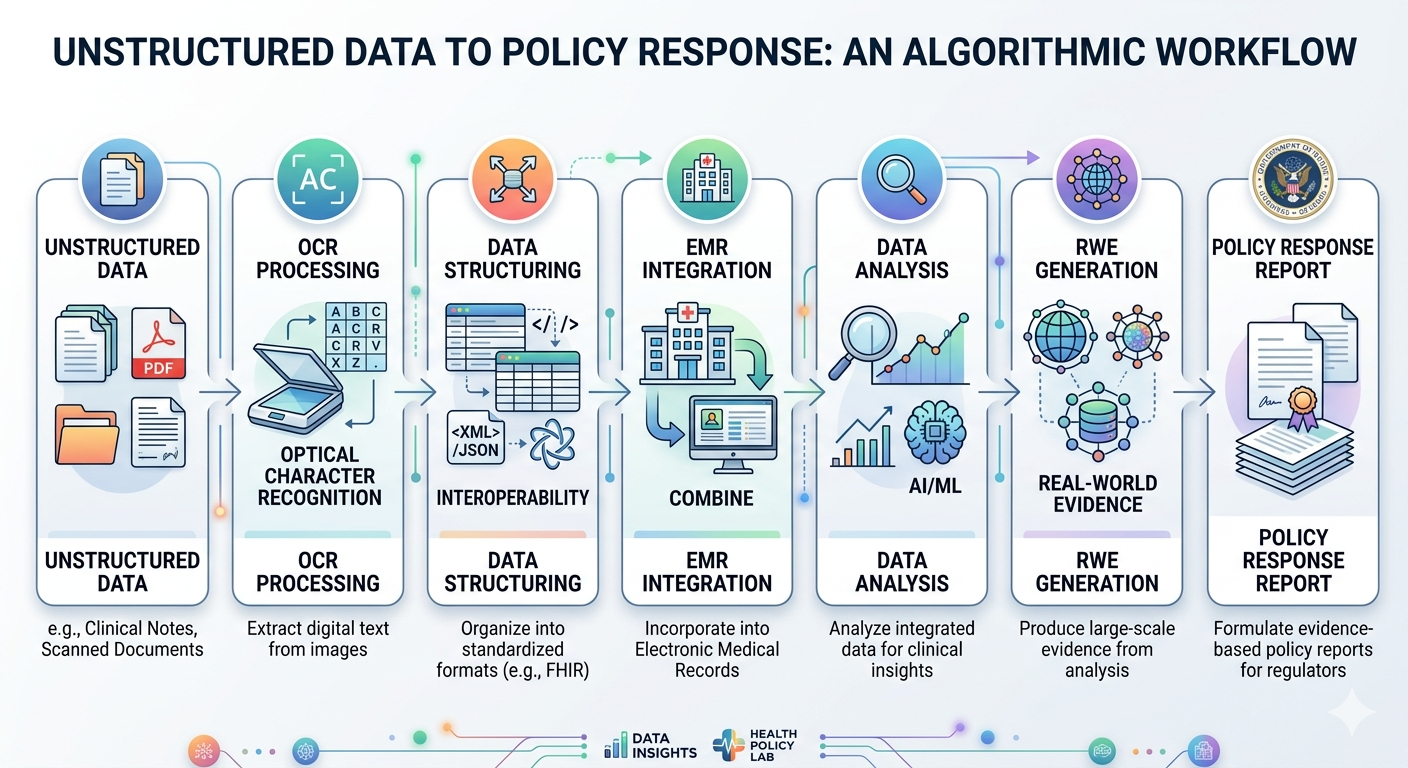
Unstructured data is first collected and processed through OCR-based extraction and structuring. The processed data is then integrated with EMR datasets to construct patient-level datasets. Subsequently, data standardization and harmonization processes ensure coding alignment and data quality control. Based on this integrated dataset, real-world evidence (RWE) is generated. Finally, the analytical outputs are translated into policy-oriented documentation.
In this process, data is not merely an analytical asset but is transformed into evidence for pharmaceutical value assessment and policy decision-making. Therefore, the objective of data processing is not analysis itself, but the generation of actionable evidence for policy use.
6. Integrated Data Processing Approach and MediTrans Case Study
As the importance of real-world evidence (RWE) continues to grow, efforts to integrate fragmented hospital data and convert unstructured clinical information into analyzable datasets are expanding. The objective of this approach is to generate actionable evidence for policy and decision-making rather than simple data collection.
MediTrans addresses these needs by implementing an integrated data processing framework that combines OCR-based unstructured data processing with EMR integration. In particular, its proprietary service, Doctor’s Note, applies OCR technology to convert clinical documents and image-based records into structured datasets.
This OCR system processes various unstructured sources such as laboratory reports, radiology interpretations, and clinical records. After text extraction, clinically meaningful entities are refined and structured, enabling previously underutilized data to be incorporated into analysis and expanding overall data completeness.
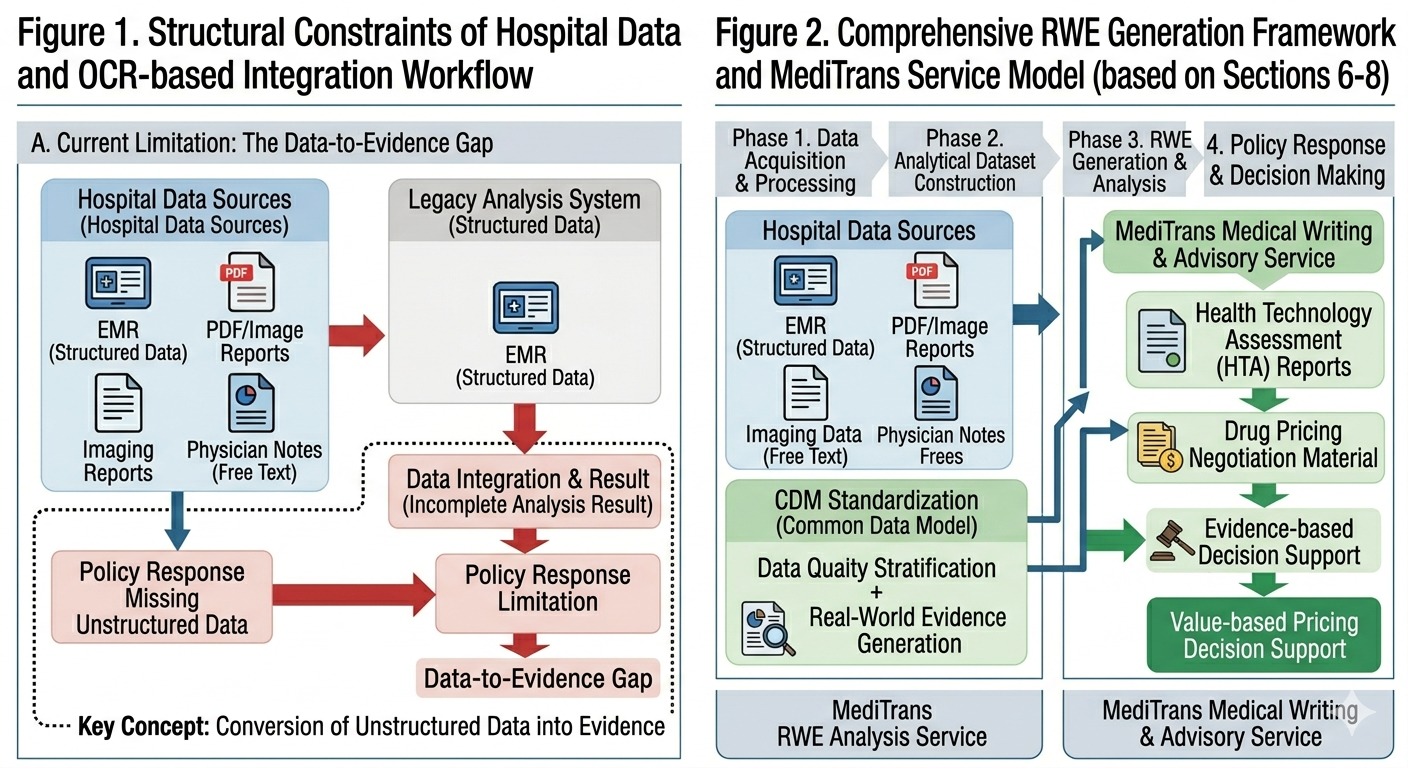
The data processing workflow of MediTrans is structured as follows:
First, diverse unstructured clinical data such as laboratory results, radiology reports, and clinical notes are collected from healthcare institutions.
Second, OCR technology applied in Doctor’s Note extracts text from documents and images, structuring them into clinically meaningful units.
Third, the structured data is integrated with existing EMR data to construct patient-level datasets.
Fourth, data standardization and harmonization processes align coding systems and ensure data quality.
Fifth, the integrated dataset is analyzed to generate real-world evidence (RWE), including treatment outcomes, survival rates, and healthcare resource utilization.
Sixth, the analytical results are documented for pharmaceutical pricing evaluation and policy response through medical writing.
This approach integrates data collection, processing, analysis, and documentation into a continuous and unified workflow.
Compared to approaches relying solely on structured data, inclusion of unstructured data offers significant advantages. It minimizes missing clinical information, improves analytical reliability, enables more precise patient stratification, and strengthens the evidentiary value of policy responses.
Ultimately, MediTrans’ approach represents an integrated data processing model that transforms fragmented hospital data into policy-relevant evidence for healthcare decision-making.
7. Discussion
The 2026 pharmaceutical pricing reform should be understood not merely as a pricing adjustment, but as a shift toward a data-driven decision-making system. In particular, the introduction of post-launch performance evaluation implies that drug value is no longer fixed at launch but continuously reassessed based on real-world outcomes.
This transformation has several structural implications for the pharmaceutical industry:
First, the paradigm of evidence generation is changing. Instead of relying on limited clinical trial data at a single time point, continuous real-world data-driven evidence generation is required.
Second, the importance of data infrastructure is increasing. Beyond data acquisition, the ability to integrate and structure heterogeneous datasets is becoming critical, especially when incorporating unstructured data.
Third, there is a qualitative shift in data utilization. Data ownership alone is insufficient; the ability to transform data into policy-relevant RWE is essential.
Fourth, unstructured data is gaining strategic importance. Previously underutilized data sources contain rich clinical insights that can significantly improve analytical precision and realism.
In conclusion, the pharmaceutical pricing reform requires not only an increase in data volume but also the establishment of an integrated evidence-generation system that ensures data completeness, interoperability, and interpretability.
8. Conclusion
The 2026 pharmaceutical pricing reform represents a pivotal transition toward a data-driven drug evaluation system. In particular, the adoption of real-world evidence-based assessment implies that drug value is continuously redefined based on clinical outcomes rather than fixed at a single point in time.
In this environment, the core competency required of stakeholders is not merely data acquisition, but the ability to transform data into policy-usable evidence.
To achieve this, the following elements must be integrated:
- Incorporation of unstructured clinical data
- OCR-based data extraction and structuring
- Integration with EMR systems
- Construction of analyzable datasets
- Generation of real-world evidence (RWE)
- Policy-oriented medical writing
These elements must operate not as isolated steps but as a fully integrated continuous workflow.
Therefore, in future pharmaceutical evaluation systems, competitive advantage will depend less on data possession and more on the capability to transform data into actionable evidence.
If you require support in data-driven drug evaluation, RWE generation, OCR-based data structuring, or pricing policy strategy, MediTrans provides integrated data processing and evidence generation services.

 Sign in with Kakao to continue