

1. Introduction
As the volume and complexity of healthcare data continue to grow rapidly, the role of Medical Writing is expanding beyond simple document creation into a data-driven evidence generation process. In the past, medical writing was often viewed as the final stage of summarizing clinical trial results or research materials. However, it is now evolving into a specialized discipline that participates across the entire lifecycle of medical data structuring and interpretation.
This transformation is driven by the structural characteristics of healthcare data environments. Clinical data generated in hospitals and research institutions exists at massive scale, yet it is distributed across multiple systems and document formats, with a significant portion remaining unstructured. Laboratory reports, diagnostic interpretations, clinical notes, scanned documents, and PDF files all contain critical clinical information, but are often difficult to directly analyze or utilize.
In such environments, simply collecting data is not sufficient to generate meaningful medical evidence. Data must be structured, clinically interpreted, and documented through expert review. In this process, medical writing functions not merely as documentation, but as a critical stage that transforms raw medical data into evidence.
This white paper examines the role of medical writing within the context of medical data structuring and OCR-based unstructured data processing, and explores its importance in data-driven healthcare knowledge management systems.
2. Changes in the Healthcare Data Landscape
In recent years, data-driven decision-making has rapidly expanded across the healthcare sector. The use of data in clinical care, medical research, and healthcare record management has increased significantly, resulting in the accumulation of healthcare information in increasingly diverse formats.
Since the adoption of Electronic Medical Records (EMR), the volume of healthcare data has grown substantially. Laboratory results, imaging reports, prescription records, and clinical notes are now stored digitally. However, not all of this data exists in an analyzable format. In real-world clinical settings, a significant portion still exists as unstructured data, such as scanned documents, PDF reports, and image-based records.
Although this unstructured data contains rich clinical information generated in practice, its usability is limited due to the lack of standardized structure. As a result, healthcare data is abundant, but the infrastructure required to systematically analyze and utilize it remains insufficient.
This shift also impacts the role of medical writing, as it increasingly requires not only textual editing but also the ability to understand and structure heterogeneous medical data.
3. Structural Limitations in Healthcare Data Utilization
One of the primary challenges in healthcare data utilization is fragmentation across multiple formats. Clinical data generated in hospitals includes laboratory values, imaging reports, physician notes, and treatment records, many of which remain unstructured.
For example, laboratory results may be stored as PDF files, diagnostic reports as narrative text, and clinical notes as free-form documentation. While these contain essential clinical insights, they are not readily usable for analysis or structured documentation.
In addition, differences in documentation standards and storage systems across institutions make data integration and comparison difficult. Even for identical test items, variations in terminology and format reduce consistency and increase the effort required for harmonization.
These structural limitations directly affect medical writing processes. Without properly structured data, it becomes difficult to produce evidence-based documents, and the reliability of outputs may be compromised. Therefore, healthcare data challenges should be understood not merely as technical issues, but as structural limitations directly linked to the quality of medical writing.
4. The Need for OCR-Based Medical Data Structuring
To effectively utilize unstructured healthcare data, a structuring process is essential. One of the key technologies enabling this transformation is Optical Character Recognition (OCR).
OCR technology converts documents, images, and scanned files into machine-readable text, enabling further analysis. By transforming unstructured materials such as laboratory reports, diagnostic records, and medical documents into structured formats, OCR establishes the foundation for data utilization.
In particular, since many clinical records still exist in paper-based or scanned PDF formats, OCR enables previously inaccessible data to be converted into analyzable forms, expanding the scope and completeness of healthcare data.
OCR-based structuring is therefore not merely a technical step, but a fundamental process for ensuring data integrity and usability, enabling more accurate clinical documentation and research outputs.
5. Connecting Data Structuring and Medical Writing
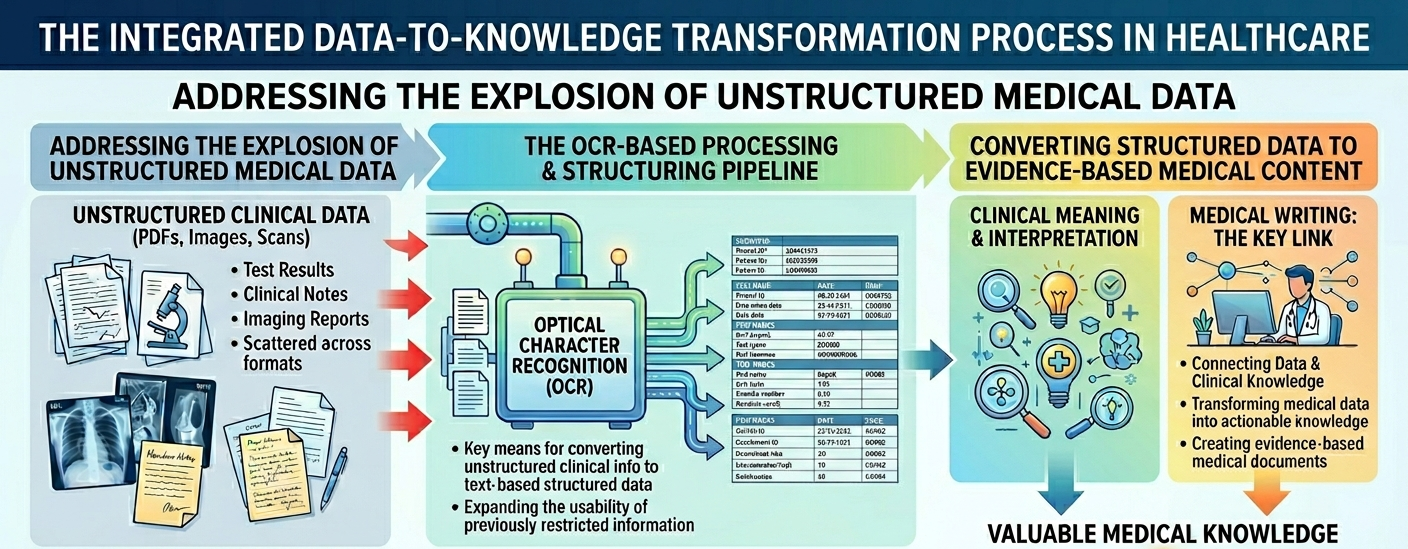
Once healthcare data is structured, it must be interpreted and transformed into meaningful evidence. In this stage, medical writing plays a critical role.
Medical writing is not simply about producing text; it involves interpreting clinical data and organizing it into scientifically valid evidence. This includes analyzing structured datasets and translating them into research outputs or medical documentation.
This process requires both medical expertise and data interpretation capabilities. Data alone cannot generate meaningful evidence; expert review and interpretation are essential to ensure reliability and clinical validity.
Ultimately, medical writing serves as a bridge between structured data and clinical knowledge, transforming healthcare data into actionable and evidence-based information.
6. An Integrated Medical Writing Approach and MediTrans Case
An integrated approach to medical data structuring and medical writing is becoming increasingly important in healthcare content management. When data collection, structuring, interpretation, and documentation are performed independently, efficiency and consistency may be compromised.
Based on extensive experience in healthcare content management, MediTrans has adopted an approach that extends medical writing into a data-driven evidence generation process. Initially focused on medical terminology standardization through the development of a medical dictionary application, the organization has evolved to enhance medical writing workflows in collaboration with global MDs and Ph.D-level experts.
Recently, OCR-based medical record processing has been introduced to structure unstructured data and integrate it into medical writing workflows. Clinical materials such as diagnostic reports, clinical notes, and laboratory results are first structured, then interpreted and documented through expert collaboration.
This approach represents a shift in medical writing from a documentation function to an integrated discipline encompassing medical data management and evidence generation.
7. Discussion
As healthcare data environments evolve, the role of medical writing continues to expand. It is no longer limited to document preparation but increasingly includes data structuring and clinical interpretation.
Advances in OCR-based data structuring technologies have significantly broadened the scope of medical writing by enabling the utilization of previously inaccessible unstructured data.
In addition, global expert collaboration and data-driven methodologies are shaping a new paradigm in healthcare content management. Medical writing is emerging as a discipline that transforms medical data into evidence, and its importance is expected to continue growing in future healthcare ecosystems.
8. Conclusion
The increasing volume of healthcare data and the expansion of unstructured information are fundamentally transforming the role of medical writing. Medical data structuring and OCR-based processing are essential processes for converting information into usable formats, enabling medical writing to function as a bridge between data and evidence.
In the future healthcare environment, expertise in understanding, structuring, and translating data into clinical evidence will become increasingly important. An integrated approach combining OCR technology and expert collaboration represents a new direction for medical writing and healthcare data utilization.
Medical data structuring, OCR-based processing, and medical writing are emerging as core components of healthcare knowledge management, and their importance is expected to continue expanding across research and clinical documentation ecosystems.
Medical data structuring and medical writing are no longer separate processes but an integrated workflow for generating data-driven healthcare knowledge. When unstructured data structuring, OCR-based processing, and expert-driven medical writing are combined, healthcare information can be transformed from simple records into reliable evidence.
For organizations seeking an integrated approach to medical writing, medical data structuring, and OCR-based processing, MediTrans supports healthcare content management and data-driven medical writing workflow development.

 Sign in with Kakao to continue